
Lowndes Parole and Probation
Parole is a conditional release from an Mississippi Department of Corrections sentence. The person remains under state authority while living in the community and must follow the terms set for that release. Probation is a court-ordered community sentence. It may follow jail time, but it can also be imposed without any state-prison release. Earned-release supervision is a third status. It permits an eligible person to serve part of an MDOC term in the community while still under MDOC jurisdiction. None of these terms means that the sentence has ended.
The document that created the status matters. A parole action comes from the Mississippi State Parole Board and is carried out through MDOC. A probation order comes from the sentencing court. An MDOC public result may help confirm parole, yet the tool is titled Parolees Search. It should not be described as a complete public list of every person on probation in Lowndes County.
| Status | How it begins | Best verification record |
|---|---|---|
| Parole | Conditional release during an MDOC sentence | Parole Board action, MDOC status, and local office confirmation |
| Probation | Order entered by the sentencing court | Filed court order and MDOC Community Corrections confirmation |
| Earned-release supervision | Statutory conditional release under MDOC jurisdiction | MDOC offender time sheet and supervision entry |
| Discharge | Supervision or sentence obligations end | Final MDOC or court record, not an old search result |
- Parole
- Conditional community release before a state sentence fully expires.
- Probation
- Court-ordered community supervision that may be imposed instead of incarceration.
- Flat Time Date
- An MDOC record field tied to the full term; it is not proof that supervision has ended.
- Absconder
- An agency status linked to alleged failure to report or remain available for supervision.
Verify Lowndes Post-Release Supervision
Begin with a full name and an MDOC identification number when one is known. The public parolee form accepts first name, last name, or MDOC ID. Compare the date of birth, photo, offense, and other identifiers before treating a result as a match. A result may list County Supervised, region or area, an officer when populated, offenses, and a Flat Time Date. Avoid copying a displayed street address. The useful fact is the supervising county or office.
- Search the MDOC Parolees Search with the most exact identifier available. Try a careful name variant only if the first query fails.
- Match the person through stable details. A shared name alone is not enough.
- Read County Supervised and region or area. If Lowndes appears, note the record date and contact the Columbus office.
- For probation, obtain the sentencing or probation order from the correct court because the public parole tool does not promise full probation coverage.
- Ask the local MDOC office for the proper public-record route to current releasable status. Do not seek protected case-management details.
- For completed supervision, request a discharge record rather than relying on an old page, an absent page, or a passed Flat Time Date.
The Lowndes County criminal case may sit in Circuit Court for a felony, Justice Court for a county misdemeanor or felony preliminary, or Municipal Court for a Columbus matter. The court order proves what the judge ordered. MDOC proves the state supervision record. The jail booking and release sheet proves when physical custody at the county facility changed. These records should not be merged into one event.
Note: An empty parolee search is a reason to check the court and MDOC office, not proof that supervision ended.
Lowndes Supervision Office Details
The Lowndes Probation & Parole Office is an MDOC Community Corrections office. It is not a jail and does not release people through a gate. Its role is supervision, reporting guidance, and routing public questions about a Lowndes County parole or probation record. MDOC lists Jason Carney as Community Corrections Director. Since the official listing gives no public hours or walk-in rules, call first rather than assuming that an unscheduled visit is allowed.
MDOC Lowndes Probation & Parole Office1207-B US-45 North
Columbus, MS 39705
Mailing: PO Box 9520
Phone: 662-241-4051
Fax: 662-241-4053
Hours: Not published; call to confirm
The manifest capture of the official Lowndes supervision-office listing shows the state source used for these contact details.
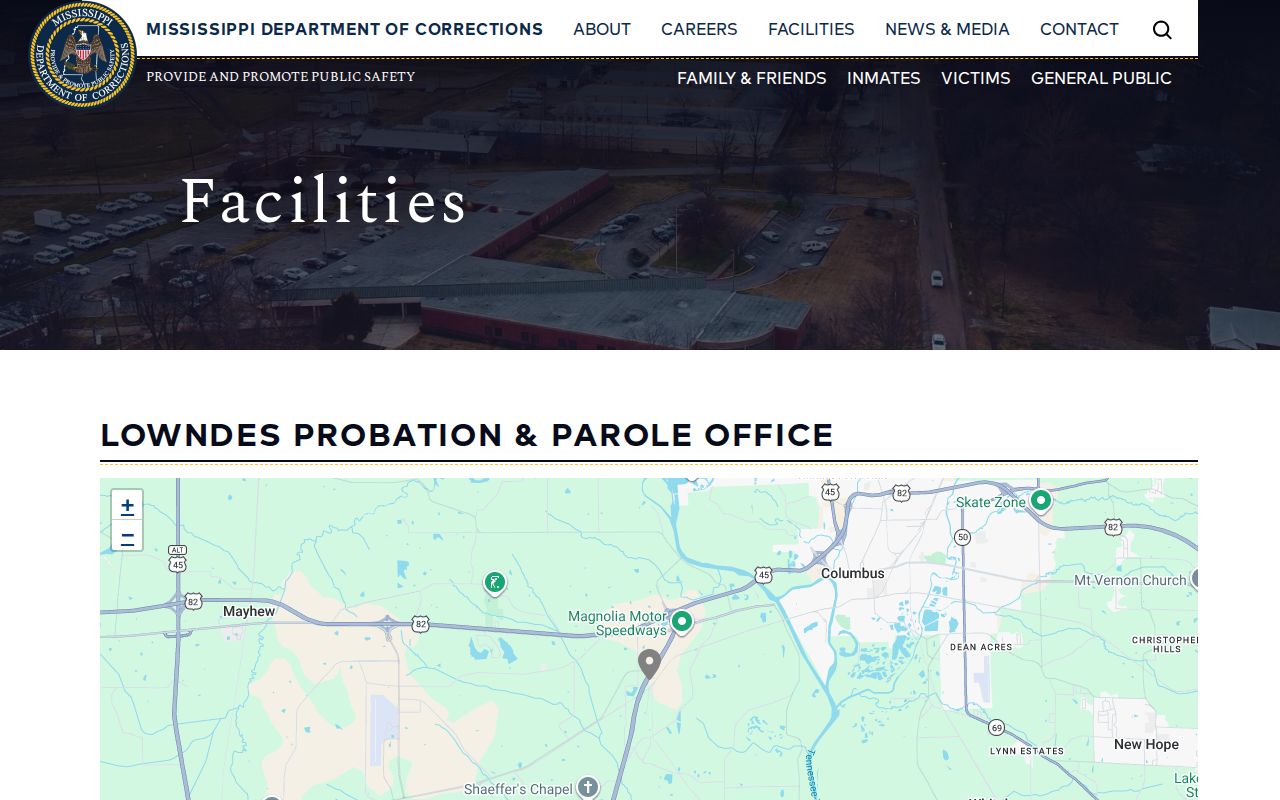
That listing confirms the Columbus office as a Community Corrections location, while the lack of posted hours makes telephone confirmation important.
Lowndes Supervision Status Changes
Conditions are the rules attached to community supervision. Their exact wording belongs in the person’s court order, parole certificate, or MDOC papers. A suspected violation may lead to an agency response, a court filing, return to custody, or revocation, which means supervision is withdrawn and custody may resume. It does not follow that every missed contact creates the same result. The case record and agency status control.
No official public Lowndes County absconder or warrant list was verified. Failure to Report may appear as an agency classification, but only MDOC or a warrant record can establish that status in a specific case. An MS SAVIN/VINE alert may report an abscond event or return to custody. That alert helps track a change; it is not an adjudicated warrant record. Read the event text and source agency, then confirm with the agency that entered it.
Lowndes Supervision and Discharge
Supervision ends through an official discharge or other controlling action, not merely because a date has passed on a public record. A Flat Time Date may be useful context, but the research did not establish it as proof of current status. Request the current releasable supervision or discharge record from MDOC when the end date matters. For probation, use the filed court record and the office that administered the order.
Parole eligibility, a parole grant, physical release, community supervision, and final discharge are separate milestones. The Board action explains its decision. The MDOC release transaction shows what followed. The local office can route a status inquiry. If the inquiry begins with a Lowndes jail release rather than an MDOC sentence, use the county release-record path described on the Lowndes County released inmates search and do not assume a state record exists.
Note: A person may leave the Lowndes jail without ever appearing in MDOC’s parolee search.
Lowndes Parole Hearing Records
The Mississippi State Parole Board makes parole decisions. No public hearing calendar or decisions-search page was verified. Board rules describe an eligibility-driven process: a hearing must occur no later than thirty days before the month of parole eligibility, and a matter may proceed by file review, in person, by telephone, or through teleconference. Hearings are closed to the public.
The verified decision terms are grant and deny. A denial action sheet states reasons and sets a later hearing. The Board keeps a minute book of official actions and reasons, but requests may be limited by rules that protect victims, confidential sources, safety details, and parts of a reentry plan. Ask the Board for a releasable action sheet or minute entry. Do not turn eligibility into a promised release date. A grant still must be followed by the MDOC custody and supervision records that show what actually happened.
Administrative rules also distinguish cases that require hearings from some cases that may proceed without one when all stated criteria are met. Sex offenses, crimes of violence, and geriatric-parole matters require hearings. Other eligible cases may depend on the case plan, conduct, victim request, conditions, and discharge plan. Offense and conviction dates can change the analysis. Read the current rule and individual action rather than applying a broad label to every Lowndes County case.
Mississippi State Parole Board239 North Lamar Street, Suite 501
Jackson, Mississippi
Phone: 601-576-3520
Email: MSStateParoleBoard@mdoc.state.ms.us
Confirm ZIP because official sources differ between 39201 and 39202.
Lowndes Reentry Assistance
MDOC’s Pathway to Re-entry Resource Guide identifies a Resource Assistance Program for people who remain under Community Corrections supervision. It also lists the Columbus Region 2 office and a Clay/Lowndes program coordinator. The guide dates from 2022, so staff names and service details should be confirmed before anyone relies on them. Its sound use is as a starting point for referrals, not a promise that a specific service or appointment is available.
The same guide identifies statewide 211 as a referral channel. A person under Lowndes County supervision should still follow the written directions from the supervising office. A family member seeking public status should call the office and keep the request narrow. Reentry support, reporting requirements, and public-record access serve different needs, even when the same Community Corrections office helps route them.
Release assistance does not itself confirm parole or probation. A program referral may be current while a public supervision record is delayed, and an old guide may name staff who have changed. Confirm the service through the Columbus office, then use MDOC or the sentencing court for the status record. This separation protects accuracy and keeps a practical referral from becoming an unsupported statement about a person’s legal obligations.
Public Record Search
Sponsored Results